What President Gordon B. Hinckley Said About Polygamy
What President Gordon B. Hinckley Said About Polygamy
President Gordon B. Hinckley (Church President, 1995–2008) spoke more plainly and publicly about polygamy than any modern LDS prophet. His statements are significant because they reflect modern prophetic framing, not 19th-century theology.
1. “It Is Not Doctrinal”
In a widely cited 1998 interview on Larry King Live, President Hinckley was asked directly whether polygamy was doctrinal.
His response was unambiguous:
- “I condemn it, yes, as a practice, because I think it is not doctrinal.”
— Gordon B. Hinckley, Larry King Live, Sept. 8, 1998
This statement is notable for two reasons:
- He did not say polygamy was doctrinal but discontinued.
- He explicitly stated that it is not doctrinal, even while acknowledging it existed historically.
This marks a decisive shift away from earlier claims that polygamy was an eternal or necessary principle.
2. “We Are Not a Polygamous People”
In the same interview, President Hinckley emphasized that polygamy has no place in the modern Church:
“We have nothing to do with those practicing polygamy. They are not members of this Church.”
He further clarified that anyone practicing plural marriage is excommunicated.
This establishes that:
- Polygamy is not merely inactive,
- It is incompatible with Church membership.
3. Historical Acknowledgment Without Endorsement
President Hinckley consistently acknowledged that polygamy existed in the Church’s past, but he refused to theologize it.
He did not:
- Defend it as God’s ideal,
- Describe it as eternally necessary,
- Teach that it would return,
- Or frame it as essential to exaltation.
Instead, he treated it as a historical practice that ended, without attempting to preserve its theological justifications.
This silence on eternal necessity is doctrinally meaningful.
4. Strong Moral Condemnation of Abuse and Coercion
In an April 2006 priesthood session of General Conference, President Hinckley addressed abuse within families, including plural-marriage contexts.
He declared:
“Any man who abuses women or children is unworthy to hold the priesthood of God.”
While not limited to polygamy, this statement directly undercuts past theological frameworks that:
- Framed women’s suffering as obedience,
- Justified coercive marital arrangements,
- Or sanctified fear-based compliance.
His language reflects moral clarity, not historical defensiveness.
5. What President Hinckley Did Not Say
Just as important is what President Hinckley never said:
- He never said polygamy was required for exaltation.
- He never said it was God’s ideal form of marriage.
- He never said belief in it was necessary for testimony.
- He never said it would return.
- He never defended 19th-century justifications for it.
Given his willingness to speak plainly on controversial topics, this absence is doctrinally significant.
6. Doctrinal Implications of Hinckley’s Statements
President Hinckley’s teachings imply several important conclusions:
- Polygamy is not a doctrinal pillar
If it were, it could not be condemned as “not doctrinal.” - Polygamy is not essential to prophetic authority
The Church’s truth claims continue without it. - Modern prophetic authority does not rest on defending past practices
Correction does not equal collapse. - Moral clarity takes precedence over historical justification
Abuse and coercion are condemned outright, not contextualized.
7. Hinckley and “Faith Without Fear”
President Hinckley’s approach aligns closely with 2 Timothy 1:7:
- “God hath not given us the spirit of fear; but of power, and of love, and of a sound mind.”
Rather than asking members to defend polygamy to preserve faith, he:
- Removed it from the doctrinal load,
- Clarified present truth,
- And allowed faith to rest on Christ, covenants, and moral clarity.
Summary: Hinckley’s Bottom Line
President Gordon B. Hinckley taught that:
- Polygamy existed historically,
- It is not doctrinal,
- It is not practiced,
- It is not acceptable,
- It is not required,
And it has no place in the Church today.
In doing so, he effectively affirmed the principle that:
Polygamy was not a pillar—now or ever.
What President Hinckley Said about Polygamy
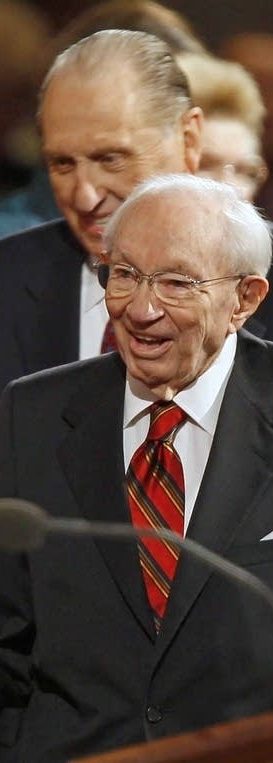
President Hinckley, "I condemn it (Polygamy) as practice, it is not doctrinal, it is not legal"- 14:30-14:44
Why Hinckley Matters
President Gordon B. Hinckley matters in discussions of polygamy because he spoke plainly, publicly, and without fear at a moment when the Church no longer needed to defend the practice for survival.
Unlike 19th-century leaders, President Hinckley did not frame polygamy as a divine requirement, a test of obedience, or an eternal principle. Instead, he stated clearly that it is “not doctrinal,” affirmed that it has no place in the Church, and drew a firm moral line against abuse and coercion. He acknowledged the past without attempting to preserve its justifications.
This matters because doctrine in the Church is established not by isolated historical claims, but by sustained prophetic teaching. When a modern prophet with global visibility declines to defend a practice—and explicitly distances the Church from it—that silence is doctrinally meaningful.
Hinckley’s approach did not weaken faith. It strengthened it. By removing polygamy from the doctrinal load-bearing structure, he allowed testimony to rest where it belongs: on Christ, covenant, and moral clarity rather than fear of historical collapse.
In that sense, President Hinckley did not merely comment on polygamy. He demonstrated how a living Restoration moves forward—by correcting without collapsing, and by choosing truth without fear.
No vel natum everti audiam. Causae voluptua in pro, sea legere alterum no. Viderer labitur legimus no usu, at usu primis efficiantur. Nam voluptaria dissentiet comprehensam ea, ex verear menandri consequuntur vis. At decore essent corpora duo, te ius tale simul impedit.
Mutat semper epicuri ex nec. Augue deseruisse ne qui. Eu nam essent persius delenit, te eum oblique conceptam incorrupte, debet adversarium vix ne. Porro facer zril mel eu, dicunt facilis ea sit. Eu usu persius bonorum oportere, nec nibh velit ornatus no.