History, Hearsay, and Hard Evidence: A Legal Review of Joseph Smith and Polygamy
This page examines the claim that Joseph Smith practiced polygamy using basic legal evidence standards, not theology, belief, or later church tradition.
The question addressed here is simple: What could be established using admissible evidence in a court of law?
Legal Standards Used in This Review
This analysis applies evidentiary principles familiar to 19th-century American courts and still relevant today:
- Primary vs. secondary evidence
- Firsthand testimony vs. hearsay
- Contemporaneous records vs. later recollections
- Sworn statements vs. unsworn claims
- Corroborated evidence vs. isolated assertions
- Physical evidence vs. narrative claims
-----------------------------------------------------------------------------------------------------
Evidence That Can Be Verified
1. Joseph Smith’s Own Statements
What we have
- Multiple public denials that he practiced polygamy
- Statements published during his lifetime
- Appeared in official church publications
Why this matters legally
- These are direct statements from the accused
- They are contemporaneous, not reconstructed later
- Courts give substantial weight to such evidence unless clearly disproven
Legal weight: High
Sources
- Times and Seasons 3, no. 15 (1842):https://archive.org/details/timesandseasons03nauv/page/868
- Elders’ Journal 1, no. 3 (1838):https://archive.org/details/eldersjournal01latt
- Joseph Smith public denials (compiled):https://www.josephsmithpapers.org
2. Civil and Criminal Records
What we have
- No arrest, indictment, trial, or conviction for polygamy, bigamy, or adultery
- Illinois law at the time criminalized bigamy
Why this matters legally
- Government records are considered best evidence
- Years of scrutiny produced no legal finding of polygamy
Legal weight: High (negative evidence)
Sources
- Illinois Revised Statutes (1833 & 1845), Bigamy laws:https://archive.org/details/revisedlawsofill00illi
- Hancock County & Nauvoo legal context:https://www.jstor.org/stable/10.5406/j.ctt13x1p0r
- Oaks & Hill, Carthage Conspiracy: https://www.press.uillinois.edu/books/?id=p019132
3. Sworn Affidavits from the Nauvoo Period (1842–1844)
What we have
- Signed affidavits from Emma Smith and other Nauvoo residents
- Collected while Joseph Smith was alive
- Explicitly deny polygamy
Why this matters legally
- These statements were sworn, with penalties for false testimony
- Possible bias does not automatically invalidate sworn evidence
Legal weight: Moderate to High
Sources
- Nauvoo affidavits published in Times and Seasons:https://archive.org/details/timesandseasons03nauv
- Emma Hale Smith affidavit (1842):https://contentdm.lib.byu.edu/digital/collection/RelEd/id/5605
- Nauvoo Relief Society Minutes (1842) https://www.josephsmithpapers.org/paper-summary/nauvoo-relief-society-minutes/1
4. Marriage Documentation
What we have
- No verified marriage licenses showing Joseph Smith married to multiple wives
- No contemporaneous civil records supporting plural marriages
Why this matters legally
- Courts strongly prefer documentary proof
- If legal marriages occurred, documentation would normally exist
Legal weight: Moderate (absence favors the defense)
Sources
- Hancock County marriage records: https://www.hancockcountyil.gov
- Bushman, Rough Stone Rolling: https://www.penguinrandomhouse.com/books/120837
- Compton, In Sacred Loneliness: https://signaturebooks.com/books/p/in-sacred-loneliness
5. DNA and Biological Evidence
What we have
- Joseph Smith had multiple confirmed biological children with Emma Smith
No verified DNA evidence links him to children with other women
- Multiple alleged descendant lines have tested negative
Why this matters legally
- DNA is high-quality physical evidence
- Sustained sexual relationships usually leave biological traces
- The absence of such evidence is legally significant
Legal weight: Moderate to High (negative physical evidence)
Sources
- Ugo A. Perego et al., Journal of Mormon History (2012): https://digitalcommons.usu.edu/mormonhistory/vol38/iss3/
- Perego, “Joseph Smith and DNA Evidence”:https://scholarsarchive.byu.edu/msr/vol15/iss2/1
- Nauvoo Smith family birth records: https://www.familysearch.org
-----------------------------------------------------------------------------------------------------
Evidence That Is Legally Weak or Hearsay
6. Late Reminiscences
What we have
- Statements recorded 20–50 years after Joseph Smith’s death
- Often collected after polygamy was established in Utah
Why this matters legally
- Memory degradation
- Retrospective theological influence
Legal weight: Low
Sources
- Andrew Jenson, Historical Record: https://archive.org/details/historicalrecord06jens
- Joseph F. Smith affidavit collections: https://catalog.churchofjesuschrist.org
- Evidence standards on memory (legal overview): https://www.law.cornell.edu/wex/hearsay
7. Third-Party Claims (“Someone Said That…”)
What we have
- Repeated statements without firsthand observation
Why this matters legally
- Classic hearsay
- Not subject to cross-examination
Legal weight: Very Low
Sources
- Wigmore, Evidence in Trials at Common Law: https://archive.org/details/evidenceintrials05wigm
- Common-law hearsay doctrine overview: https://www.britannica.com/topic/hearsay
8. Utah-Era Affidavits
What we have
- Statements gathered decades later
- Produced under legal and institutional pressure
Why this matters legally
- Strong incentive to retroactively justify polygamy
Legal weight: Low to Moderate
Sources
- B. Carmon Hardy, Solemn Covenant: https://www.press.uillinois.edu/books/?id=p052875
- Federal anti-polygamy prosecutions context: https://www.loc.gov/collections/united-states-statutes-at-large
9. Claims of Secret Ceremonies Without Documentation
What we have
- Assertions without contemporaneous records
Why this matters legally
- Violates the best evidence principle
Legal weight: Low
Sources
- Best Evidence Rule (legal overview):https://www.law.cornell.edu/wex/best_evidence_rule
- Wigmore, Evidence, Vol. 4: https://archive.org/details/evidenceintrials04wigm
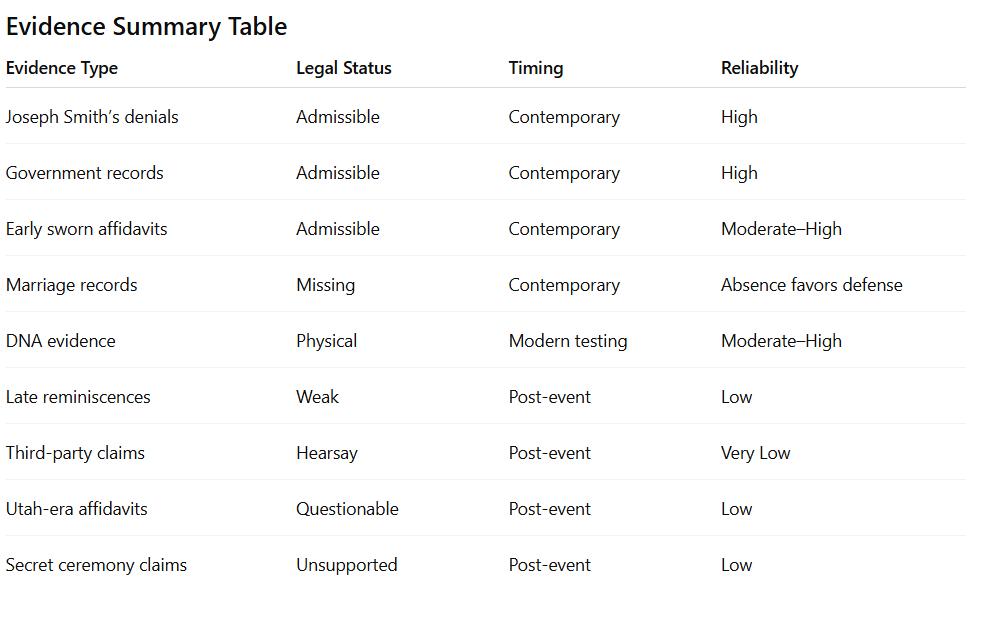
Legal Conclusion
Applying standard legal reasoning:
- Criminal standard: Not met
- Civil standard: Weak and contested
- Historically provable using admissible evidence: Not established
A court could not reliably conclude that Joseph Smith practiced polygamy based primarily on hearsay and post-event testimony when contemporaneous sworn denials, lack of legal documentation, and absence of biological evidence exist.
Final Note
This analysis does not claim absolute certainty.
It explains only what can and cannot be established using legal evidence standards.